
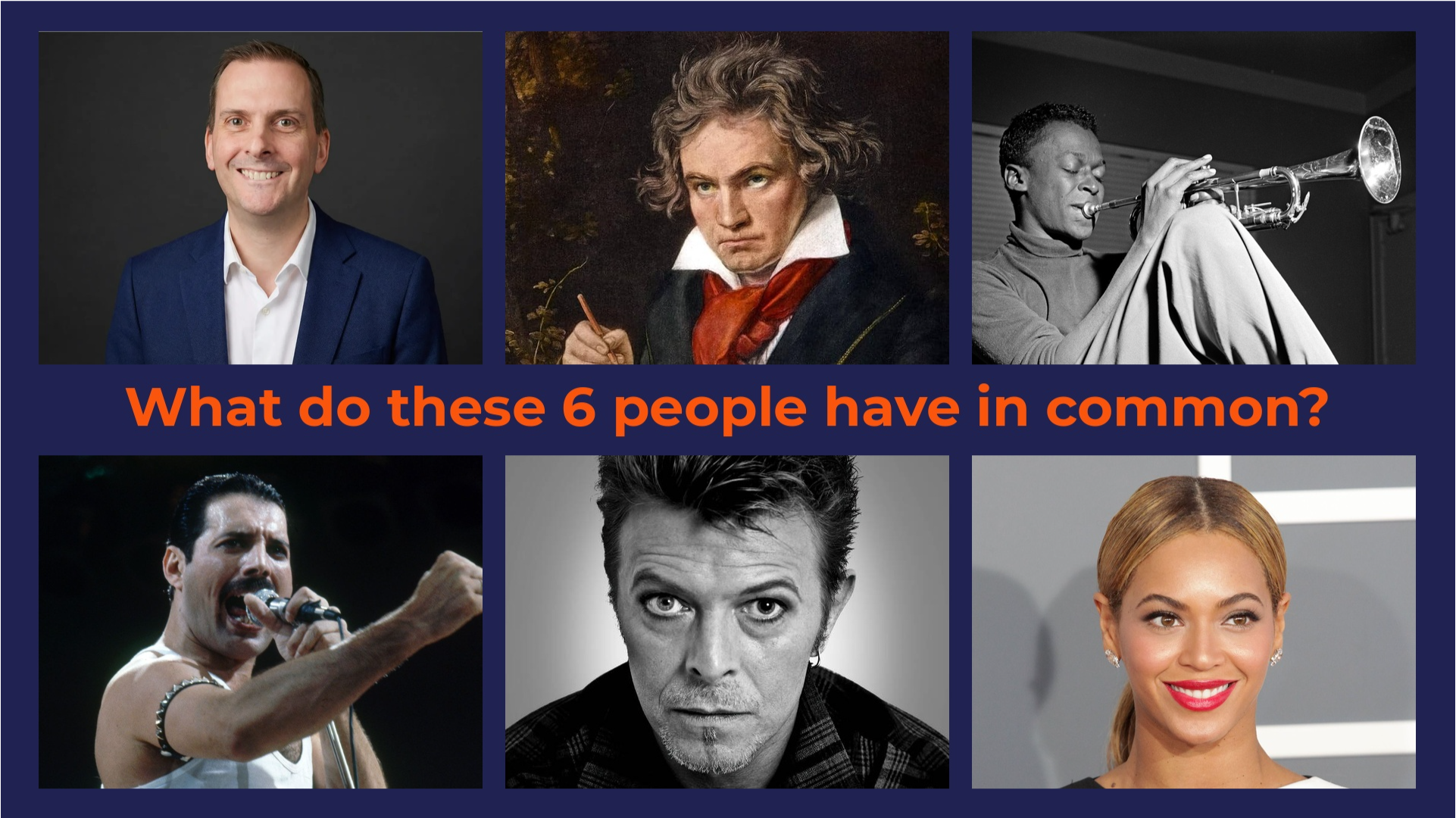
What Hubris, I hear you cry! Comparing yourself to these icons...
But go with me on this...I make no claim to be as good, successful, ground-breaking, or talented in any way, but this post is about Leadership Lessons, and it is here that I can draw comparisons.
It was a Tuesday evening in Shanghai. I was at the bar in the Four Seasons with a group of colleagues after a long day, and a jazz quartet was playing in the corner. Someone said, “Ralph, why don’t you get up and sing?”
My immediate reaction was no. The room was packed. Hundreds of people. I had not warmed up. I had not spoken to the band. I did not know their key or their feel or whether they would be remotely willing to have a stranger walk onto their stage. There was every reason to say no.
My colleagues kept at it. Eventually, one of them walked over to the pianist and told him his friend wanted to sing. I watched the pianist turn to the rest of the band. Quizzical looks. That slightly pained expression that says: we’re professionals; we don’t particularly want some random person ruining our set. They said yes anyway.
I walked up. They asked what I wanted to sing. I suggested “How High the Moon,” and that we fold in “Ornithology.” The pianist raised an eyebrow. Then they started.
We moved between the two songs. The crowd cheered. I walked off stage with my heart still beating too fast and a very large grin on my face.
What struck me afterwards was not that it had gone well. It was why it had gone well. No rehearsal. No preparation. Musicians I had never met and never spoken to. And yet something real was created, in front of hundreds of people, that none of us had planned.
That night stays with me. And the more time I have spent leading businesses, the more I have come to believe that the thing that made it work in that bar in Shanghai is the same thing that separates exceptional leaders from ordinary ones.
Before I moved into business, I trained as a professional classical and jazz singer and performed worldwide. For years, those two parts of my life felt like chapters in different books. Music was the before. Business was the after.
They were never separate at all.
The skills required to perform at the highest musical level and the qualities that define exceptional leadership are, in many cases, identical. The ability to hold a vision that others cannot yet see. The discipline to prepare beyond what anyone will observe. The courage to change before change becomes necessary. The capacity to work with people you have never met and create something none of you could have made alone.
Great musicians have been demonstrating these qualities for centuries. Most business leaders walk straight past the lessons.
What follows draws on five musicians from vastly different eras and genres. A classical composer. A jazz visionary. A rock icon. A shapeshifter. A perfectionist. Each one has something specific and valuable to say about what leadership actually requires. Not in theory. In practice.
1. Ludwig van Beethoven: Lead from vision, not from circumstance
Beethoven composed the Ninth Symphony while profoundly deaf.
Musicologists debate the precise extent of his hearing loss in those final years. What is not in dispute is that by the time he was writing the Ninth, he had been almost entirely unable to hear for some time. He could not hear orchestras rehearse. He could not hold a conversation without writing notes on paper. When the symphony was premiered in Vienna on 7 May 1824 at the Theater am Kärntnertor, he had to be physically turned to face the audience because he could not hear the ovation. He experienced that moment entirely through the sight of 1,500 people on their feet.
And yet what he produced stands as one of the most complex, emotionally rich, and structurally precise works ever written.
The lesson here is not simply about persevering through adversity, though it is certainly that. It is about the relationship between vision and circumstance. Beethoven did not wait until conditions improved. He did not scale back his ambitions to match his limitations. He held the vision with such clarity that the external environment became, in a meaningful sense, secondary to the work itself.
Most leaders allow circumstances to define what they believe is possible. A difficult market, a challenging team, limited resources, an uncertain economic outlook: these become the reasons why the original vision gets quietly reduced, reframed, or abandoned altogether. Beethoven’s life is a direct argument against that pattern.
The vision comes first. The circumstances are the problem to solve around it, not the other way round.
2. Miles Davis: Build the team, then trust it
Rolling Stone once described Miles Davis as “the most revered jazz trumpeter of all time.” That is, if anything, an understatement of his broader influence on music.
What is discussed far less often is what made him an exceptional leader of people.
Davis built bands. Repeatedly. The musicians who passed through his ensembles over four decades read like a catalogue of jazz greatness: John Coltrane, Bill Evans, Herbie Hancock, Wayne Shorter, Chick Corea, and Keith Jarrett. These were not session players hired to execute instructions. They were world-class talents in their own right, many of whom went on to define the genre entirely on their own terms.
His approach to leading them was striking in its simplicity. He hired people who were exceptional at things he was not. He gave them space to take the music somewhere he had not anticipated. And when what they produced exceeded his expectations, he moved the whole ensemble in that direction rather than pulling them back to a predetermined plan.
He was famously spare with direction in rehearsal. His guidance was often oblique, sometimes a single cryptic phrase. He wanted musicians to interpret, not to replicate. The result was music that could not have been planned in advance, because it required genuine creative autonomy to exist at all.
There is something in that Shanghai bar that speaks directly to this. Walking onto a stage with musicians I had never met, agreeing only on a song title and a key, and trusting that what emerged would be worth something. No script. Just skill, shared language, and the willingness to follow where the music led.
That is what Davis built. Repeatedly. And the parallel for business leaders is direct.
Hiring brilliant people and then overseeing every detail of their work is one of the most common and most costly mistakes in leadership. Davis understood something that many executives still wrestle with: your function is not to be the most capable person in the room. Your function is to create the conditions in which the most capable people in the room produce the best work of their lives.
Hire well. Point the direction. Then step back.
3. Freddie Mercury: Presence is a skill, not a gift
There has never been a live performer quite like Freddie Mercury.
Imagine being in that stadium. Wembley, July 1985. Seventy-two thousand people, the noise a physical thing you feel in your chest, the heat of the afternoon still radiating off the pitch. And then Mercury walks to the front of the stage, and the whole thing shifts. He opens his mouth, throws his arm out, and 72,000 strangers become a single organism.
His now-legendary “Ay-Oh” call-and-response with the crowd is one of the most extraordinary moments in the history of live performance. Mercury invented the melody on the spot. The crowd sang it back. He extended it, pushed it further, and the crowd followed him everywhere he went. Within minutes, he had that entire stadium doing exactly what he wanted. Clapping in unison. Singing. Responding to his every gesture.
It was not simply charisma that some people are born with and others are not. It was deliberate, practised, and executed with extraordinary precision.
What most people miss is the sheer volume of work behind that apparent ease. Mercury spent years on the road developing his stagecraft. He worked obsessively on movement, on vocal dynamics, on the specific mechanics of directing the energy of a large crowd. Every gesture, every pause, every moment of silence was considered. The spontaneity was built on a foundation of relentless preparation.
Leaders consistently underestimate the importance of presence as a skill. The ability to walk into a room and shift its atmosphere. To communicate conviction without slides or supporting material. To inspire action through how you carry yourself, not merely through what you say. These are not peripheral skills. They are among the most valuable qualities a leader can develop.
Presence is not something you either have or do not have. It is built. Mercury constructed his over years of performing, failing, watching, and refining. Leaders can do exactly the same: through practice, honest feedback, and the commitment to genuinely connect with people rather than simply deliver information to them.
4. David Bowie: Reinvention is strategy, not crisis
Across five decades in music, David Bowie reinvented himself more times than most artists manage to sustain a single identity. Ziggy Stardust. Aladdin Sane. The Thin White Duke. The Berlin trilogy. Let’s Dance. Black Star. Each transformation disoriented a section of his audience. Each one was deliberate.
What is remarkable about Bowie is not that he changed. It is that he changed at a time of his own choosing, before his current form had exhausted itself. In July 1973, at the peak of Ziggy Stardust’s cultural moment, he walked onto the stage at the Hammersmith Odeon and announced that it was the last Ziggy Stardust show they would ever see. The audience had no idea it was coming. Bowie had already decided. The market had not told him to move on. He told the market.
That requires a specific and unusual kind of courage. The willingness to set aside something that is working, even though you can see it will eventually stop working. Most people wait for the evidence. Bowie moved on intelligence and instinct, well ahead of external confirmation.
Business leaders face exactly this dynamic. The most dangerous period for any organisation is often a sustained run of success. Success creates attachment to the model that produced it. The market shifts, competitors adapt, and companies keep doubling down on the strategy that previously worked, right up until the point where it stops.
Watch the horizon rather than the scoreboard. Know when your current identity has done all it can. Be willing to step into the discomfort of reinvention before circumstances force your hand. The leaders who do this proactively tend to build organisations with genuine longevity. Those who wait for a crisis to prompt change tend to find that the reinvention is far more painful, and the results far less certain.
5. Beyoncé: Own your standard and hold it without apology
Beyoncé is, by most measures, the most successful solo artist of her generation. She is also, by consistent account from everyone who has worked with her, one of the most demanding.
The stories are remarkably consistent across decades of interviews and behind-the-scenes documentation. Nothing is released until it meets her standard. Creative decisions, from choreography to lighting rigs to album sequencing, are made with an attention to detail that most productions simply do not attempt.
The 2019 Netflix documentary Homecoming offered a rare window into what genuine creative standards look like in practice. It follows her 2018 headline performance at Coachella: months of gruelling rehearsals, intensive physical conditioning (including returning to full training less than a year after giving birth to twins), and the construction of a stage designed to resemble university stadium bleachers, complete with a full orchestra, a marching band, and dozens of dancers moving with the precision of a single instrument. Nobody puts that kind of preparation into something they are willing to let fall short.
The standard she sets for herself becomes the standard for everyone around her. When the person at the centre operates at that level, mediocrity has nowhere to hide.
This is one of the most important truths about organisational culture that leaders frequently miss. You can write values on a wall. You can run workshops on excellence. You can build performance frameworks and review processes. But what people in any organisation actually calibrate to is what the leader accepts. The standard is set by what you tolerate, not by what you declare.
Equally worth noting is Beyoncé’s trajectory as a business owner. Since releasing her 2011 album 4 through her own company, Parkwood Entertainment, she has owned the master recordings of her work outright. She has taken progressive, deliberate control of her music, her brand, and her business interests, not because she was forced to, but because she built deliberately towards it over many years.
For any founder or business owner, that trajectory is worth studying. Ownership of your creative and commercial output matters more than most people recognise, and the time to start building towards it is before you need it.
What music and leadership share
These five musicians operated in entirely different worlds. The concert halls of late eighteenth-century Vienna and the festival stages of contemporary California have almost nothing in common on the surface.
But look at what they shared.
Each one held a vision that did not bend to circumstance. Each one understood the difference between talented individuals and a high-performing ensemble. Each one worked deliberately on the craft of presence and communication. Each one knew when the current chapter had run its course and had the courage to begin a new one. And each one set a standard so clear that everyone around them either rose to meet it or moved on.
Those are not musical qualities. They are leadership qualities.
I did not recognise this when I was training as a singer. I thought I was learning about music. Looking back, I was learning about vision, discipline, performance under pressure, and what happens when preparation meets a moment you did not plan for.
That night in Shanghai, I was not ready. But it went brilliantly. Because jazz, like leadership, is not about having everything mapped in advance. It is about being so deeply prepared, so genuinely present, and so willing to work with the people around you, that you can create something worth creating even when nobody handed you a script.
The best leadership lessons are rarely where you expect to find them.
Look in unexpected places. The lessons are there.
(And, as a footnote, to reiterate my opening sentences, I do not consider myself to be worthy to be in the same image as these five brilliant musicians and artists. I certainly do not compare myself to them in any way musically, as a performer, or as a successful artist. But it did get you to be curious and take a look!!)