We’ve Got You Covered

Lead Generation
Social media Ads, Google ads or totally free lead gen strategies; we have the tried & proven know-how to get you qualified leads that convert.

Social Media Management
Managing your socials doesn't have to be overwhelming. Save time on scheduling content and responding to comments and messages.

Content Creation
Whether you need blog posts, website copy, or social media updates, we can help you stand out from the pack and attract more customers.

Sales Funnels
We specialise in creating a custom funnels that fits your unique needs and helps you convert more leads into customers.

Reputation Management
With our Review Request System™, we can help you build a positive online presence and ensure that your customers see you as the best option.

SMS Marketing
Incredibly effective way to reach new customers, increase loyalty among current customers, and drive more sales at low cost. When done right.

Website Development
We'll work with you to create a website that reflects your unique brand and that will help you stand out from the competition.

Email Marketing
We'll help you create eye-catching emails that will grab your readers' attention, and turn it into action in form of more replies and sales.



NEW DATES: NLP PRACTITIONER COURSE - 2ND - 8TH MARCH 2026 - CLICK HERE
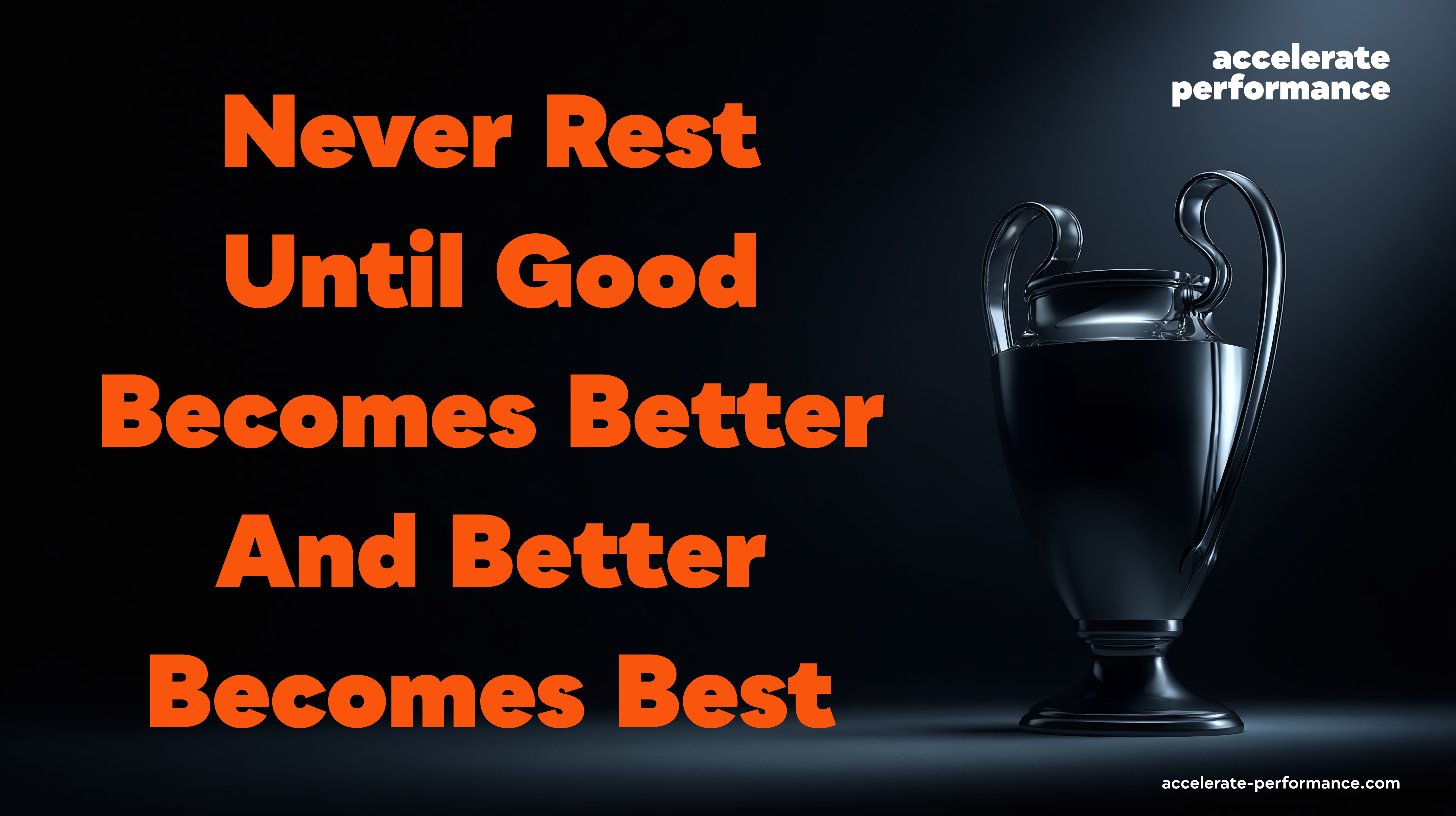
Never Rest Until Good Becomes Better — And Better Becomes Best | Accelerate Performance
St. Jerome said it in the 4th century. The words still land today.
"Never rest until good becomes better and better becomes best."
I've spent nearly 30 years driving performance in sales, marketing, and growth roles. I've coached executives through transformations that seemed impossible at the start. The pattern repeats: the leaders who outperform their rivals share one trait.
They refuse to settle.
The Three-Stage Progression That Separates Winners
Good gets you in the game. Better keeps you competitive. Best creates distance between you and everyone else.
Most organisations stop at good. They hit targets, celebrate wins, then coast. The problem shows up 18 months later when competitors who kept pushing have moved ahead.
I watched this play out with a sales leader I coached last year. His team hit 103% of quota in Q1. He wanted to celebrate. I asked what would happen if they aimed for 115% in Q2.
He looked uncomfortable.
That discomfort matters. It signals the gap between current performance and potential. Executive coaching exists to close that gap.
Why Coaching Drives Continuous Improvement
Research shows executive coaching delivers a 788% return on investment. The reason is simple: coaching creates structured accountability for getting better.
You can't improve what you don't measure. You can't measure what you don't define. Coaching forces clarity on both.
In my practice, I've seen coaching increase individual performance by 70% and organisational performance by 48%. These aren't abstract numbers. They represent real revenue growth, faster deal cycles, and stronger team retention.
The kaizen philosophy from Japanese manufacturing applies here: small, continuous improvements compound into massive advantages over time. One fifth of your inputs drive the greatest returns. Coaching helps you identify that critical 20% and optimise it relentlessly.
The Perception Gap That Holds Leaders Back
Many executives overestimate their growth mindset.
I see this constantly. Leaders believe they demonstrate continuous improvement. Their teams disagree. The gap between self-perception and reality creates blind spots that limit performance.
External perspective solves this. A coach provides the mirror you need to see what you're missing. Not to criticise, but to illuminate opportunities for improvement you can't spot from inside your own experience.
Daily goal structure drives performance. Visualisation increases motivation. Mental toughness requires discipline. These aren't platitudes. They're frameworks that work when you apply them consistently.
From Theory to Execution
St. Jerome's quote isn't about perfection. It's about progression.
Good means you've built competence. Better means you're refining your approach. Best means you've created a system for continuous improvement that doesn't depend on motivation or willpower.
I built my coaching practice on real-world experience, not just theory. I've made the mistakes, fallen into the traps, and learned what actually works when you're trying to drive performance under pressure.
The executives who achieve best-in-class results share three habits:
They measure everything. You can't improve what you don't track. Performance data reveals patterns you'd otherwise miss.
They seek external perspective. Coaching provides the accountability and insight that internal teams can't offer. The ROI speaks for itself: 500-700% returns are common when coaching focuses on behaviour change.
They build systems, not rely on effort. Discipline matters more than motivation. Mental toughness comes from practice, not inspiration.
The Cost of Settling for Good
I've watched talented leaders plateau because they stopped pushing. They hit good and assumed that was enough.
It never is.
Your competitors aren't resting - especially if I’m coaching them!! Markets don't reward complacency. The gap between good and better widens faster than most people realise.
Coaching accelerates the journey from good to better to best. It provides structure, accountability, and external perspective. Most importantly, it creates the conditions for continuous improvement to become automatic rather than aspirational.
St. Jerome understood something fundamental about human performance: the moment you stop improving, you start declining. There's no neutral ground.
The question isn't whether you'll pursue better. It's whether you'll do it systematically or leave it to chance.

Never Rest Until Good Becomes Better — And Better Becomes Best | Accelerate Performance
St. Jerome said it in the 4th century. The words still land today.
"Never rest until good becomes better and better becomes best."
I've spent nearly 30 years driving performance in sales, marketing, and growth roles. I've coached executives through transformations that seemed impossible at the start. The pattern repeats: the leaders who outperform their rivals share one trait.
They refuse to settle.
The Three-Stage Progression That Separates Winners
Good gets you in the game. Better keeps you competitive. Best creates distance between you and everyone else.
Most organisations stop at good. They hit targets, celebrate wins, then coast. The problem shows up 18 months later when competitors who kept pushing have moved ahead.
I watched this play out with a sales leader I coached last year. His team hit 103% of quota in Q1. He wanted to celebrate. I asked what would happen if they aimed for 115% in Q2.
He looked uncomfortable.
That discomfort matters. It signals the gap between current performance and potential. Executive coaching exists to close that gap.
Why Coaching Drives Continuous Improvement
Research shows executive coaching delivers a 788% return on investment. The reason is simple: coaching creates structured accountability for getting better.
You can't improve what you don't measure. You can't measure what you don't define. Coaching forces clarity on both.
In my practice, I've seen coaching increase individual performance by 70% and organisational performance by 48%. These aren't abstract numbers. They represent real revenue growth, faster deal cycles, and stronger team retention.
The kaizen philosophy from Japanese manufacturing applies here: small, continuous improvements compound into massive advantages over time. One fifth of your inputs drive the greatest returns. Coaching helps you identify that critical 20% and optimise it relentlessly.
The Perception Gap That Holds Leaders Back
Many executives overestimate their growth mindset.
I see this constantly. Leaders believe they demonstrate continuous improvement. Their teams disagree. The gap between self-perception and reality creates blind spots that limit performance.
External perspective solves this. A coach provides the mirror you need to see what you're missing. Not to criticise, but to illuminate opportunities for improvement you can't spot from inside your own experience.
Daily goal structure drives performance. Visualisation increases motivation. Mental toughness requires discipline. These aren't platitudes. They're frameworks that work when you apply them consistently.
From Theory to Execution
St. Jerome's quote isn't about perfection. It's about progression.
Good means you've built competence. Better means you're refining your approach. Best means you've created a system for continuous improvement that doesn't depend on motivation or willpower.
I built my coaching practice on real-world experience, not just theory. I've made the mistakes, fallen into the traps, and learned what actually works when you're trying to drive performance under pressure.
The executives who achieve best-in-class results share three habits:
They measure everything. You can't improve what you don't track. Performance data reveals patterns you'd otherwise miss.
They seek external perspective. Coaching provides the accountability and insight that internal teams can't offer. The ROI speaks for itself: 500-700% returns are common when coaching focuses on behaviour change.
They build systems, not rely on effort. Discipline matters more than motivation. Mental toughness comes from practice, not inspiration.
The Cost of Settling for Good
I've watched talented leaders plateau because they stopped pushing. They hit good and assumed that was enough.
It never is.
Your competitors aren't resting - especially if I’m coaching them!! Markets don't reward complacency. The gap between good and better widens faster than most people realise.
Coaching accelerates the journey from good to better to best. It provides structure, accountability, and external perspective. Most importantly, it creates the conditions for continuous improvement to become automatic rather than aspirational.
St. Jerome understood something fundamental about human performance: the moment you stop improving, you start declining. There's no neutral ground.
The question isn't whether you'll pursue better. It's whether you'll do it systematically or leave it to chance.
Let our happy customers tell their story
We think our courses and coaching are great, but our customers should have the last word. Here is a selection of endorsements.
Accelerating Your Performance Every Day
Accelerate Performance is on a mission to enable people and business to achieve great things through Advisory, Coaching, Consulting, Executive Leadership Development, and Training. .
© Copyright 2013 - 2026 - Accelerate Performance
Made with ♥ In London, GB